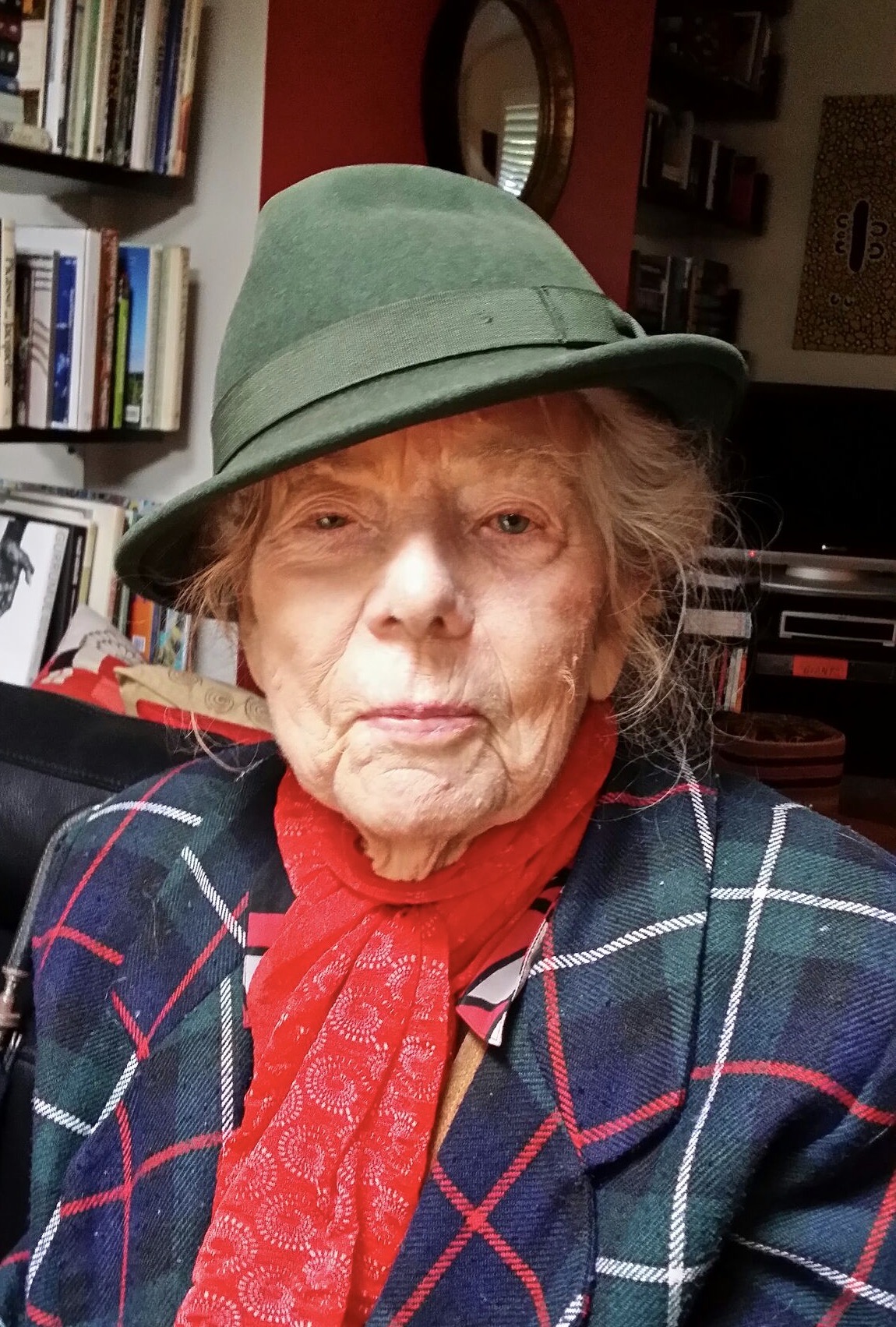
Huge congratulations to the winner of our Inaugural Hilarie Lindsay Prize! And what a fabulous afternoon! Our guest speaker, Andrew Lindsay, and judge, Angela Bowne, enlightened and entertained us, inspired and amused us, and appealed to our emotions. All with the backdrop of the Members’ Room at Parliament House, a Sparkling High Tea and lots of chatter.
Co-president Liz Newton explained that the Hilarie Lindsay Prize was created to challenge women writers nationally to submit an unpublished work of fiction or non-fiction on the subject of social justice. It was established in memory of Dr Hilarie Elizabeth Lindsay MBE OAM (1922-2021), Hilarie was a distinguished Australian writer, mentor, businesswoman, a champion of women, and proud supporter and former president of The Society of Women Writers NSW Inc. She was also a fierce advocate for social justice, a theme reflected in the breadth of her literary works.
 Guest speaker, Hilarie’s son, Andrew Lindsay’s speech:
It’s a great pleasure to be here with you all, at the inaugural awarding of the Hilarie Lindsay Prize.
Many thanks to the Society of Women Writers for deciding to administer and run this competition. Thanks to all the writers who entered their work, and congratulations to those who were shortlisted, this is already a great achievement.
Thanks also to Treasurer Amanda Mark, Past President and Editor of Ink Jan Conway, my partner Ann, Hilarie’s ally and confidant Mr Nam Tran, and Chris Lane and Lane Associates for good advice and great lawyering.
Let me tell you just a few things about Hilarie, to indicate why social justice was important to my mother …
Hilarie’s father Arthur grew up poor in Tasmania. His grandmother, Louisa, had been transported, and knew the hardship of the Cascade Female Factory in Hobart. Louisa’s little girl died in the female factory while Louisa was out on service with a family – Louisa was not allowed to have her child with her. Sarah Louisa Coates was 15 months old when she died. One of the doctors who worked at the female factory described the conditions there as ‘horrifying’ …
According to Hilarie, when her father was a boy, his Christmas gift would be a single orange … Arthur and his brother shared a coat and a pair of shoes, so that you could either wear the coat or the shoes …
Hilarie’s father became a builder, as did his brother, and his father … Arthur built many of the first homes in Mosman, before the Harbour Bridge was built. Some people thought he was paying too much money for this land, but he was convinced that Mosman would catch on. Some people said he was clairvoyant, but if he was he didn’t see Jack Lang coming, or the Great Depression …
He lost everything he had built up in his working life, apart from one house that he had built for his mum and dad … that was the house Hilarie grew up in.
To make ends meet, her mother raised chickens. Hilarie would tell me that her mother was now persona non grata, and where she would have once been invited to join those friends at their dinner table, now she was only fit for selling them the bird … and Hilarie never forgot the stink of the feathers that she helped pluck …
She never forgot the hardship she knew as a child during the Great Depression, and it was something that she had in common with my father Phil, who became the great love of her life. It was something they knew about each other … Phil’s family had also lost everything during the Great Depression, when Phil was a boy …
Phil was a gunner in a Catalina during the war, the gunners were the bottom of the pecking order, and frequently got shot up …
Over 50 years later, when Phil had cancer, I said to Hilarie, “This is difficult!”. She replied, “This isn’t difficult, difficult was during the war when I hadn’t had a letter for a week!”
After the war they built their first house together at Terrey Hills, with two young daughters in tow, lugging a sugar bag full of tools … they’d catch 3 buses from their flat in Cammeray, and it took them three years to build the place, because they could only do it on weekends … They’d sleep in a tin shed, with the legs of their bunk beds standing in jam tins, to deter the bush rats, but Hilarie never forgot the sensation of those bush rats scampering over her in the dark …
Terrey Hills was then part of Sydney’s green belt, that had been opened up to help alleviate the post war housing crisis … on the bush block we had flannel flowers, boronias, waratahs, prickly thorn bush, kookaburras, and red belly black snakes … a septic tank, and a tank for rainwater … as a kid I loved it, but now I recognise it was a poor community, and many people were doing it tough.
Hilarie’s sister now lived next door, and together they started a library, and that library continues to this day …
Hilarie had a keen eye for social justice, and she was willing to get stuck in, and fight a good fight … She was a champion in the old-fashioned sense, someone who was willing to step onto the field of battle and bear arms, and fight on behalf of us all …
I don’t know who the winner is but I’m keen to find out, and let me get in early and wish them my heartfelt congratulations, as the inaugural winner of the Society of Women Writers Hilarie Lindsay Prize …
Thank you …
Thanking Andrew for his speech, co-president Pippa Kay said, ‘I blame Hilarie for getting me started as a writer some decades ago. Hilarie and I both lived in Hunters Hill and together we started the Moocooboola Fellowship of Australian writers, which met in the Gladesville Library and is still going strong. Later I joined Patricia Gaut’s Willoughby Writing Group with Hilarie and it was through that group that I learned of the Society of Women Writers. I have a lot to thank Hilarie for. And we have a lot to thank her son, Andrew, because without his generous support, we wouldn’t have this competition.’
Pippa continued, ‘We had 69 entries and I was the Returning Officer. I made sure there were no names attached to the actual stories submitted and assigned a number to each one, then sent them to two preliminary judges – Liz Newton and Christine Sykes – who selected their ten best. This was the long list which I sent to Angela Bowne, who selected six shortlisted entries.’
Developing the longlist 2026:
Liz Newton and Christine Sykes judged the HLP longlist from the total number of entries, the entries divided randomly between them, with titles only (no author’s name). They each selected their top ten for the judge.
There were numerous issues and themes raised, and it was revealing to encounter so many issues of social justice in our community requiring intervention and attention. The word length ranged from 3 pages to 14-15 pages (upper end around 4,000-5,000 words).
The entries were varied in topic, situation and country, as well as time, e.g. present and historical. Many had a greater depth of social justice connecting the individual story to wider issues of community, law, fairness and equity, and rights. Some tackled the issue of how to enable people to change their situation.
All had women at the core, varying in ages, from young girls to older women. Most were well written and varied between first person (often memoir-ish) and third person POV. There was a mix of fiction and non-fiction prose and one poem.
Themes included:
Domestic/gender violence.
Rural/ historical and changing issues.
Old age, homelessness, euthanasia, nursing homes, dementia and lack of agency.
Impacts elderly can have on others in need.
Other cultures/women’s suppression of self and voice/disabled women and work, and racism.
Online scamming women via overseas networks.
Younger women – esteem, rape and repeated statements to prove guilt/women’s voice and gender.
Forced adoption featured in several.
Poverty and illness was also a theme as was housing and mental illness.
Climate change and the impact of protest and representation.
 Our judge, Angela Bowne, described each of the six shortlisted entries and explained how she decided on the winner. Her speech will be added here soon.
Angela Bowne SC’s practice at the NSW Bar was primarily in intellectual property, and her work has always involved writers and publishing. She has been a journalist, editor and publisher of small journals. She was a director of UNSW Press/New South Publishing for the maximum six-year term and is currently on the board of Australian Book Review. She has served on several arts boards, including Australian Theatre for Young People (ATYP) and Sydney Chamber Opera. As Chair of the ATYP Foundation, she initiated annual Foundation Commission Awards for new plays to be performed by young people and was on the judging panel for 15 years.
Angela was President of PEN Sydney (2006–2007) and was awarded honorary life membership of PEN for her services. In that role, she was a judge of the PEN Keneally Award and the Sydney PEN Award. She has served on and chaired several NSW Bar Association committees, including chairing the judging panel for the Bar’s Media Awards (2006–2008), and currently sits on its Media & Information Law & Technology Committee. In 2019 she was awarded life membership of the Copyright Society of Australia for her services to copyright owners and creators. She has convened numerous writers’ events over the years and directed the Rose Scott Women Writers’ Festival in 2018 and 2019, showcasing 54 women writers across more than 30 sessions.
The shortlisted entries and their authors (not in any order) are:
• Amanda Clarke for Learning to Disappear
• Jane McGown for Whispers
• Sadia Dubow for Letters of Suggestion
• Helen Lyne for The Depths of Ignorance
• Brielle Bates for A Resourceful Woman
• Melanie Weckert for Bus
 The winner, Sadia Dubow, lives in Victoria and was not able to join us for the presentation. This is her acceptance speech, which was read by Pippa Kay:
It is an honour and a delight to be the very first recipient of the inaugural Hilarie Lindsay Prize. Before anything else, I would like to congratulate my fellow writers who were shortlisted, those who were longlisted, and all who submitted their work to the prize. I wish I could’ve been present to celebrate with you in person.
I came across the Hilarie Lindsay prize late last year and I remember feeling pleasantly surprised at the fact that the theme was unabashedly ‘social justice.’ Often writers are told to be subtle—to suggest and imply, to show not tell. The story I submitted, titled Letters of Suggestion, is nothing like that. It is straightforward and brash, it lectures and berates; I thought it was the kind of story that might never find a home. The Hilarie Lindsay Prize truly appeared at the perfect time for me and I feel incredibly grateful to have my writing recognised with this award.
I would like to thank all the wonderful people who made a prize like this possible. Thank you to the wonderful team at The Society of Women Writers NSW, and in particular to the co-president Pippa Kay who I’ve exchanged many emails with. Thank you to the judge Angela Bowne for selecting Letters of Suggestion as the winning piece. And thank you to all of you, the community of writers and readers that surround The Society of Women Writers NSW and support this organisation in doing the work that it does. I look forward to seeing the prize re-open later this year, and wish everyone who submits all the best.
Sadia also created a video of herself, which is viewable at the top of this article. Photos taken by Rita Shaw at the function are also viewable at the top of this article.
The Society of Women Writers NSW is delighted with the outcome of this inaugural Hilarie Lindsay Prize competition and is looking forward to opening it up again in November 2026. We are extremely proud of the contribution Hilarie made to our organisation and to be able to honour her memory in words and by wearing hats, just the way she would have wanted.